
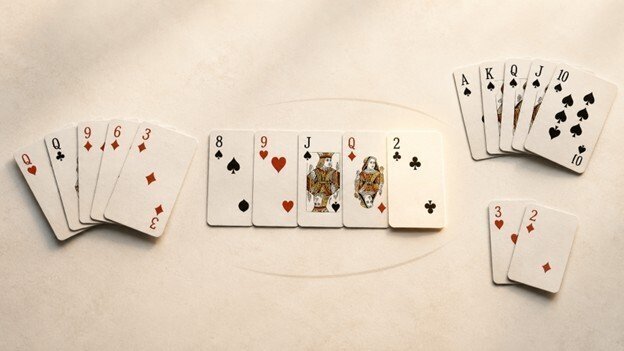
Poker hand rankings are easy to memorize but slower to recognize in motion. A chart tells you that a flush beats a straight. It does not train your eyes to notice 4 suited cards, a paired board, or a quiet full house forming while the hand is still unfolding.
That is why poker hand rankings practice should feel visual and repeated. Research on visual search expertise shows that trained observers become better at noticing task-critical features inside familiar patterns, which is exactly the kind of instinct a newer poker player is trying to build.
Turning Card Knowledge Into Recognition
A useful practice environment removes the full table noise and keeps the card pattern in front of you: this is where video poker becomes particularly useful. With 5-card draw formats, the rhythm is clean: see the starting hand, decide which cards matter, imagine the possible improvements, then read the final hand against the paytable.
If you want to see that rhythm in a clear entertainment setting, this selection of video poker games for real money presents familiar poker-hand outcomes through draw-based games, such as Jacks or Better, Double Double Bonus Poker, Joker Poker, and multi-hand versions.
This is helpful because the player is not trying to read opponents, position, or table action. The focus stays on pairs, straights, flushes, high cards, wild card possibilities, and which holds create sensible drawing paths. Once the hand-ranking ladder is understood, video poker offers a simple way to build up your familiarity with it, watching those rankings appear repeatedly, without needing a full table to produce useful card-recognition reps.
Once that 5-card pattern is clear, you can branch out into other formats and test your abilities there. For instance, this quick Pai Gow Poker quiz lets you build the same recognition skill in a different way. Pai Gow starts with 7 cards, then asks you to form a 5-card hand and a 2-card hand, with the 5-card hand ranked higher. The short quiz reinforces how both hands are compared with the dealer, why 1 matching success creates a push, and how the Joker can act as an ace or complete a straight or flush. It is not a different lesson. It is the same hand-ranking foundation tested through a split-hand format.
The Simple Pattern Reader
| Situation | What Your Eyes Should Notice | Why It Matters |
| 5 loose cards | Pair, draw, high-card value | Builds the first read before emotion takes over |
| 4 suited cards | Flush path or missed connection | Trains suit grouping instead of random card naming |
| Paired board | Trips, full house, kicker pressure | Prevents overvaluing a pretty but fragile hand |
| Split-hand format | Strong 5-card hand and legal 2-card hand | Shows how rankings change when cards must be arranged |
The table is not a checklist. It is a lens. Beginners often stare at the strongest visible card, then work backward. Better recognition moves in the opposite direction: see the structure first, then decide which card is important.
A pair of Aces can look strong because it sounds strong. But recognition asks sharper questions. Is it only 1 pair? Is the board paired? Are 3 cards already suited? Did the last card complete a straight line that was easy to miss? This is where video poker and its companion games become less about remembering names and more about reading relationships between cards.
Why Static Charts Stop Helping

A hand-ranking chart is tidy because every hand sits in the correct order. Real cards do not arrive that way. They arrive with missing pieces, partial patterns, and tempting distractions. A beginner may know the rankings perfectly yet miss that 9-10-J-Q creates a straight draw, or that 2 cards of the same suit are not meaningful until the wider texture supports them.
Repetition should be varied. Seeing only final hands teaches labels. Seeing hands before and after a draw teaches movement. Seeing 7 cards split into 2 hands teaches arrangement. Seeing a board change on the turn or river teaches reevaluation. Each format presses a different part of the same skill.
The goal is not to become robotic. It is to free up attention. When you no longer have to think hard about whether a flush beats a straight, you can spend more energy on position, action, stack depth, and what your opponent’s line represents. Recognition gives your strategy more breathing room.
Recognition Should Feel Calm
The best hand-ranking practice is not rushed, overly technical, or buried under jargon. It should feel like controlled exposure. You see a hand, name it, notice what can improve it, then notice what can beat it. Over time, the first read gets faster, and the second read gets more accurate.
That second read is where better poker thinking begins. New players often stop at “I have top pair.” Stronger players add, “top pair on what board, against what action, with what possible draws now completed?” The hand name is only the start. The meaning comes from the surrounding cards.
A relaxed practice habit can be simple. Watch how 5-card hands form, especially in formats like video poker, where the other distractions are eliminated. Pause on awkward combinations. Compare nearly identical hands. Notice when a card looks dramatic but changes little. The more patterns you see, the less you rely on memorization, which matches the broader learning idea behind visual statistical learning.













0 comments