
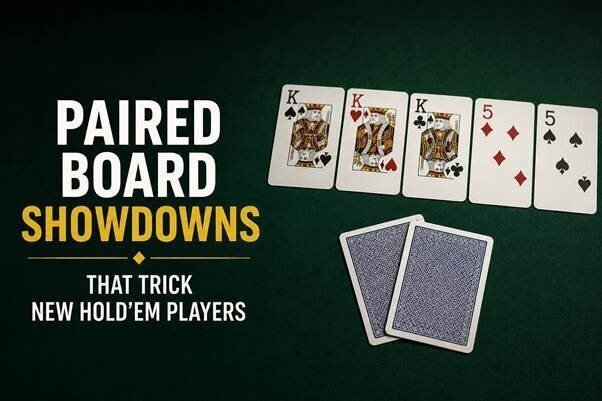
A paired board can make a strong-looking Hold'em hand feel better than it is. That is where many new players get trapped. They see their pocket pair, top pair, or trips, and keep reading the hand from their own two cards outward. The better habit is to start with the board, ask what everyone shares, and then decide which private cards still matter.
Showdown reading is a recognition skill, not just rules memory. A paired board asks you to retrieve the ranking order, apply it to five cards, and to avoid giving too much weight to things that look important but don’t have a significant impact on your position. Pattern recognition skills take time to master, but with practice, this becomes second nature.
Read the Board Before You Defend Your Hand
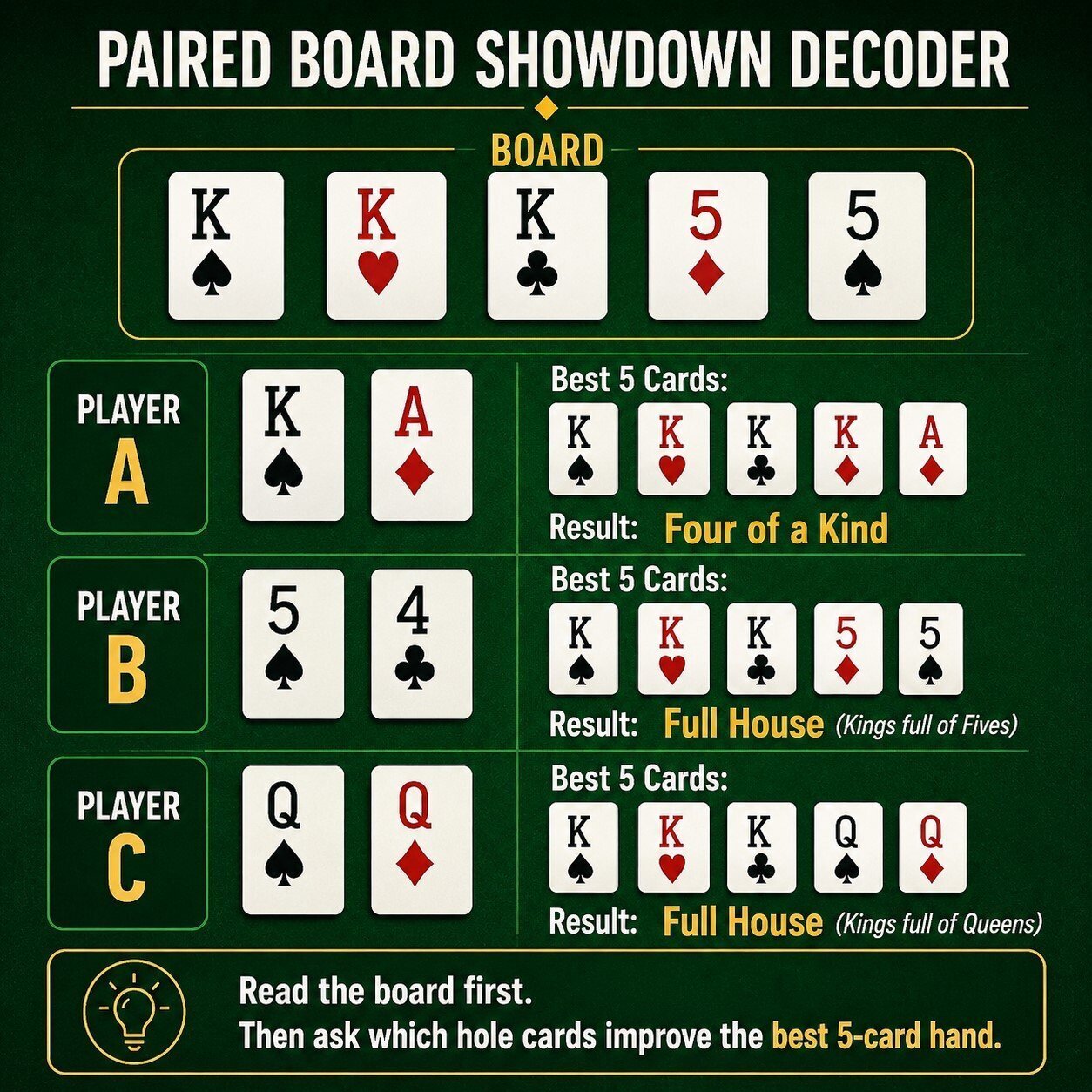
On a paired board, your hole cards do not disappear, but their job changes. A board such as K-K-7 already gives every player a pair of kings, so the real question is whether someone has cards that can improve that shared foundation. When the board develops into K-K-K-5-5, the situation becomes more compressed because the community cards already make a full house.
To see these shapes in a more natural online setting, a poker site that presents poker formats and learning resources can give players context beyond a static ranking chart. The useful lesson is not that one exact board must be memorized. It is that paired boards ask which players can improve the cards on the table.
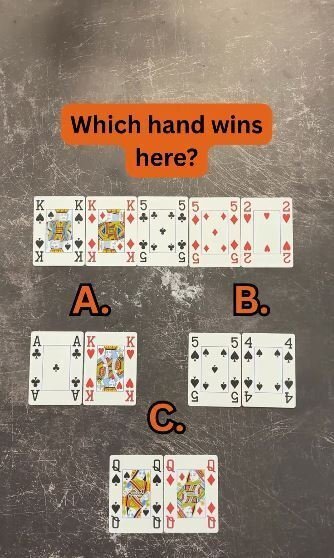
A quick test is this short poker puzzle, which asks viewers to decide which hand wins from three labeled options. It tempts the eye to jump toward private cards first. The pair of queens that C has look very powerful at first glance. If that was where your eyes went, then slow down, read the shared cards, name the strongest board-made hand, and check which option most improves the final 5-card result.
The Trap Is Emotional Ownership
New players often overvalue the cards they personally hold. Pocket queens feel powerful because queens are premium cards before the flop. A suited connector feels clever because it can make hidden hands. A lone king feels huge on a king-paired board. At showdown, none of those feelings count unless the cards improve the final hand category or rank comparison.
This is why paired boards create so many false reads. The board may already supply two pairs. It may give everyone trips. It may create a full house that only some hole cards can improve. It may also flatten the hand so completely that players split because nobody has a card that can improve what is already on the board.
When approaching a situation like this, it helps to ask yourself three important questions:
- What hand does the board already make?
- Which private cards improve that shared hand?
- If categories match, which rank comparison breaks the tie?
Those questions keep attention away from card romance. A player holding Q-Q on K-K-K-5-5 can improve the kings full of fives to make kings full of queens instead. This is a significant step up, but they should still ask themselves where the remaining king might be.
Why Kickers Sometimes Stop Mattering
Kickers matter until they do not. On K-K-7-4-2, a player with A-K beats a player with Q-K because both have trips, and the ace kicker plays. On K-K-K-5-5, those kickers can vanish because the board has already supplied a complete full house. They remember that an ace kicker is good, but often forget that a kicker only matters when it belongs inside the best 5-card hand.
It’s also important when dealing with full houses to remember that you compare the 3-of-a-kind part first, and that the pairs only make a difference when the tripled cards are tied. Kings full of queens beats kings full of fives. Fives full of kings loses to kings full of fives because the rank of the trip portion decides first. Quads are cleaner. Four kings beat any full house, and the side card only separates identical quads when both players have the same four of a kind.
A Cleaner Way to See Showdowns
The best paired-board readers are the ones who can filter out the noise. They look at the community cards, identify which cards could improve those the most, then assess their own hand to see if the improvements that they can make are strong enough to compete.
Paired boards are ordinary Hold'em spots that reward precision. Once you stop judging your hand entirely based on your pocket cards and start thinking about the strongest 5-cards you can make, the board becomes easier to read. The decision feels less dramatic because the method is steadier: shared cards first, improvement second, category third, rank comparison last. That fits broader visual attention research showing that visual search depends on how attention and working memory handle task-relevant information.














0 comments